Síguenos en Instagram

Síguenos en Instagram
Labels for non-alcoholic drinks have to make the product stand out and, at the same time, perform correctly through labelling, storage and consumption. Cold, condensation, humidity, the container type and an automatic application line can all determine the choice of material and adhesive.
Our designers and technicians work alongside the customer to find the right combination of materials, adhesives, printing and finishes, taking into account both the brand’s image and the real conditions the product will face.
Preparing a new non-alcoholic drink? Tell us about your project and we will work through the labelling solution with you.
A chilled kombucha does not have the same requirements as a mocktail served from an ice bucket, or a de-alcoholised wine that has to hold the visual identity of the rest of the range.
That is why, before manufacturing, we need to understand the product. The container, the temperature, the humidity, the application system and the finishes you want all help determine which solution will work best.
Refrigeration and condensation are the two decisive factors here. When a cold bottle moves into a warmer environment, the moisture that forms on the container can affect both the paper and the behaviour of the adhesive.
For these projects we work with wet-strength materials and adhesives selected according to the application and storage conditions.
The technical side does not mean giving up on appearance. Papers with character, foil stamping, screen printing, embossing and varnishes all allow the label to keep a natural or craft feel and stay part of the brand’s positioning.
Here the challenge is usually different. When a winery adds a de-alcoholised reference, it generally wants the consumer to keep recognising the brand and the new product to sit alongside the rest of the range.
We can bring across the techniques used in wine labelling: speciality papers, foil stamping, embossing, screen printing and relief effects.
It is also important to plan the available space for product information from the outset. Working out the distribution between front label and back label properly keeps the composition clear without sacrificing visual identity.
Mocktail labels tend to give more weight to colour, illustration and special finishes. But the design also has to answer to the conditions in which the drink is served.
If the bottle is served very cold or goes through an ice bucket, condensation, water, ice and handling all come into play. We combine moisture-resistant materials with foil stamping, screen printing, embossing or spot varnish to produce a label that looks right and is ready for those conditions.
On a drinks label, design cannot be approached purely visually. It also has to leave the space needed for the mandatory product information and present it clearly and legibly.
In the European Union, Regulation (EU) No 1169/2011 sets out the general rules on food information provided to consumers. Depending on the product, the label may need to carry the name of the food, ingredients, allergens, net quantity, date of minimum durability, storage conditions, the identity of the operator and nutritional information.
This has a direct bearing on how we approach a label. Container size, the amount of information, the hierarchy of the text and the split between front and back label all need to be considered before the design is finalised.
In the wine sector there are specific provisions for products that have undergone de-alcoholisation. European legislation provides for the term “de-alcoholised” where the actual alcoholic strength does not exceed 0.5% vol., and sets out specific labelling requirements for these products.
So when we work on labels for alcohol-free or de-alcoholised wine, it is important to know from the start what information the brand will need to carry. That allows us to work through formats, sizes and the distribution of content without compromising the final design.
We do not replace the legal or regulatory advice that is the responsibility of the producer and its own specialists. Our work begins once we know what information has to appear: we help integrate it into a label that is technically viable, legible and consistent with the product’s visual identity.
VARNISHES
PRINTING
MATERIALS
EMBOSSING
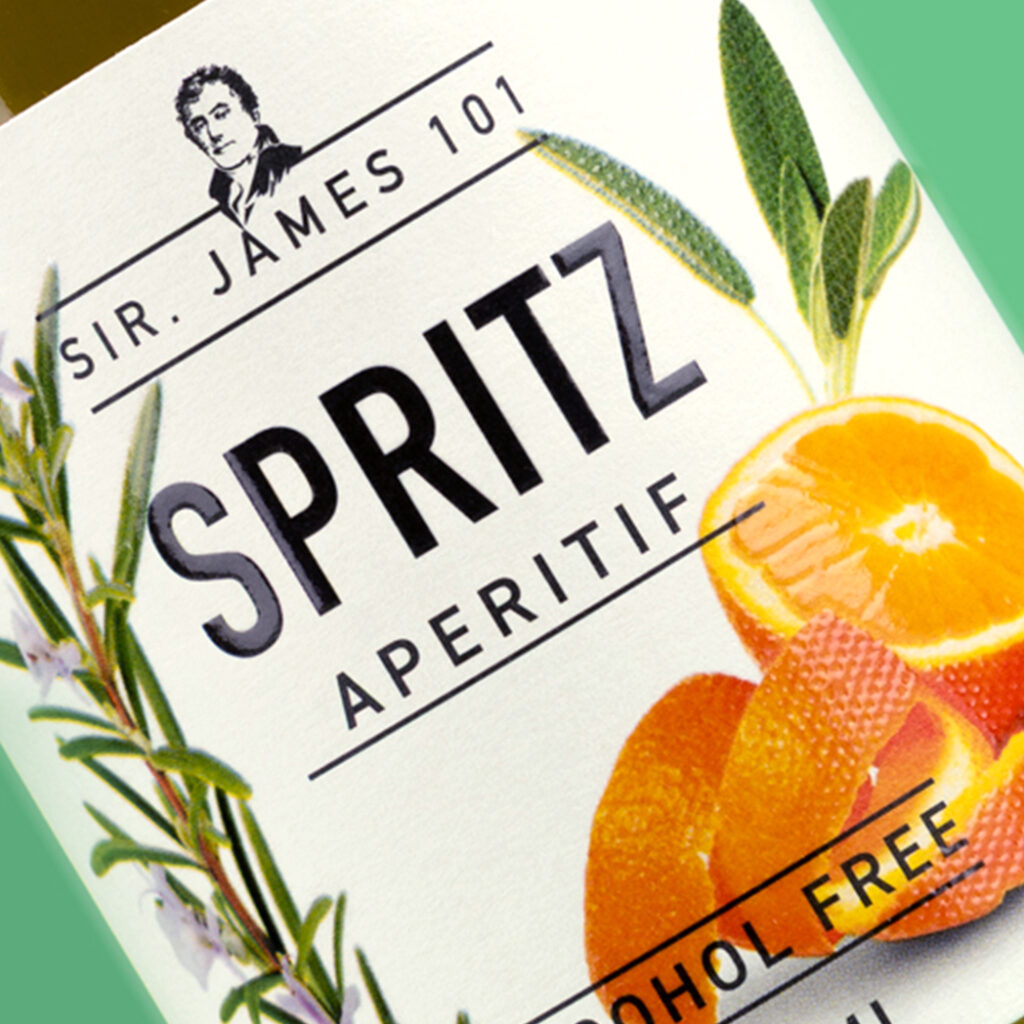
Our work for Sir. James 101, a Dutch mocktail brand with international distribution, shows how technical requirements and special finishes can work together.
For their labels we used Sorolla Ultra WS with a PET liner from Manter by Fedrigoni, a material with high cold resistance. Printing was offset, combining CMYK and Pantone.
On certain graphic elements we applied screen printing with braille varnish to reproduce the texture of fruit and leaves.
The material answers the needs of the product, while the printing and finishes reinforce its visual identity and add a tactile dimension.
This is exactly the kind of project where we aim to add most value: solving the technical side without limiting what the design can do.
As the 0.0 category grows, more non-alcoholic drinks are competing in segments where the look of the container carries real weight.
Foil stamping can bring out a brand name. Embossing adds volume and texture. Screen printing allows textures and varnish reserves, while spot varnish creates contrast between different areas of the label.
Our team works out which finishes make sense for the design, the material, the run length and the product’s positioning. Often a well-chosen finish adds more than an overloaded label.
Manufacturing labels is not simply a matter of receiving a file, printing it and delivering the order.
We want to work as a partner that wineries and drinks producers can rely on. That is why we do not have a sales team focused purely on selling. It is our designers and technicians, with years of experience, who work alongside the customer and assess what each project needs.
Nuestro soporte puede empezar antes de cerrar el diseño y continuar cuando el producto ya está en producción.
Our support can start before the design is finalised and continue once the product is in production.
This support matters most on medium and large runs, where a labelling problem can hit productivity directly.
Our goal is to make your job easier and help you find a solution that works for your day-to-day life.
It depends on the container, the application system and the storage and serving conditions. If the bottle will be chilled, subject to condensation or used in an ice bucket, it is worth looking at materials and adhesives prepared for those conditions.
We can manufacture kombucha labels using materials and adhesives selected for chilled products exposed to moisture. To recommend a specific solution we also need to know the container and the application conditions.
Yes. We can incorporate speciality papers, foil stamping, embossing, screen printing and relief effects to hold the product’s visual positioning.
Yes. We can combine materials prepared for cold and moisture with finishes that add visual and tactile impact.
Yes. Our technical team can assess the container, the storage conditions and the application system to recommend a solution suited to the project.
If you are preparing a kombucha, a mocktail, a de-alcoholised wine or another non-alcoholic drink, we can work with you from the early stages of the project.
Tell us what product you are labelling, what container you use, how it is stored, what application system you have and what result you are after. Our team will work through the materials, adhesives, printing and finishes with you.
And if you already have production running and need to solve a labelling problem, we can help with that too.
More than a label supplier, we want to be the technical partner that helps you find a reliable solution for your product and your production process.
Gráficas Alarcón
Ctra. Nacional III · Km 263,8
46300 Utiel · Valencia